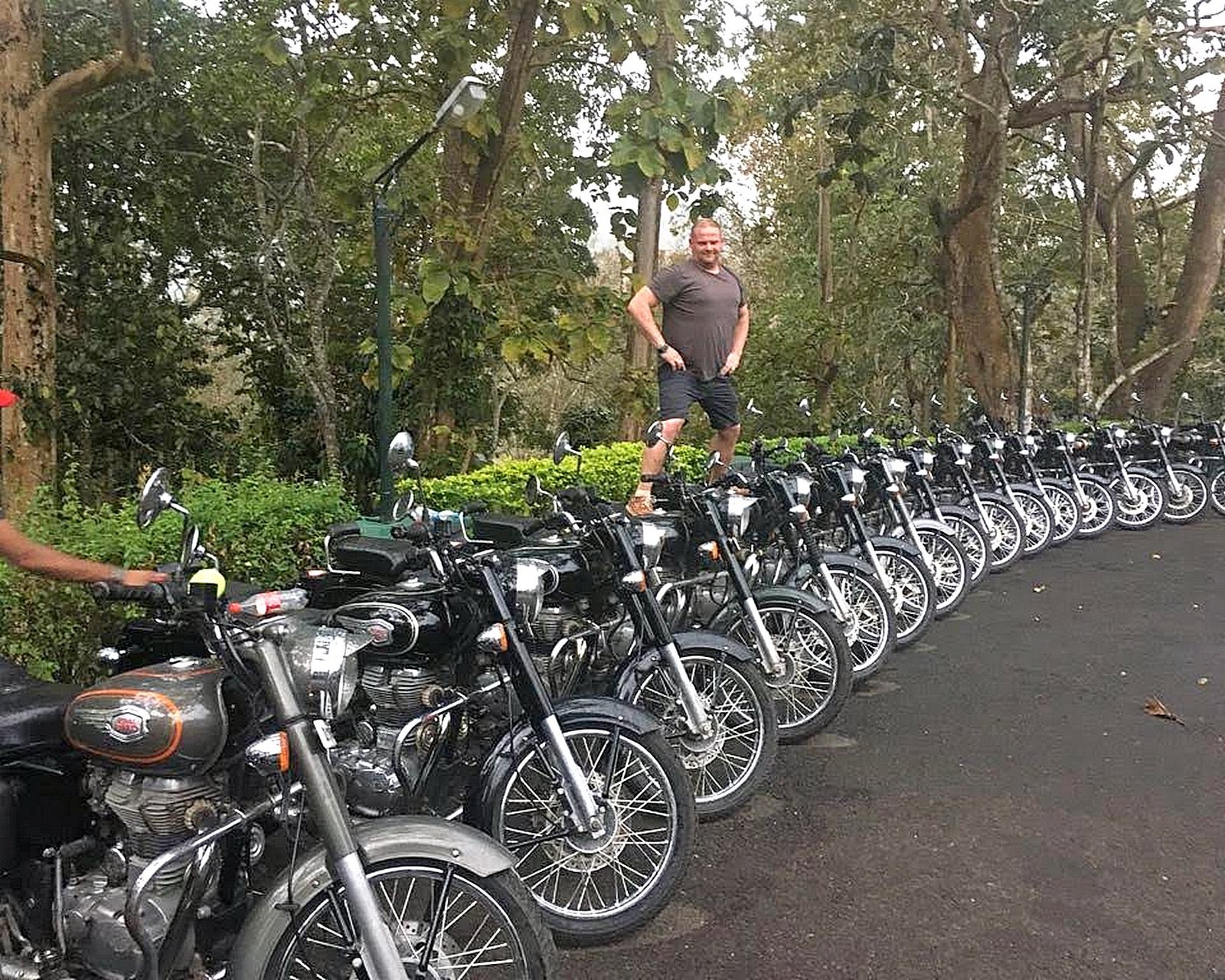
Every Ladakh trip starts with the same argument, usually in a pub, usually after the second round: Royal Enfield Himalayan or Classic? Both have been carrying riders over Khardung La for years. They go about it differently, and the numbers show exactly how.
Royal Enfield Himalayan vs Classic 500: the numbers
| Himalayan 450 | Classic 500 | |
|---|---|---|
| Engine | 452 cc, liquid-cooled | 499 cc |
| Power (sea level) | 40 hp at 8,000 rpm | 27.2 bhp at 5,250 rpm |
| Torque | 40 Nm at 5,500 rpm | 41.3 Nm at 4,000 rpm |
| Fuel system | Fuel injection | Fuel injection |
| Fuel tank | 17 liters | 13.3 liters |
| Ground clearance | 230 mm | 135 mm |
| Weight, ready to ride | about 196 to 198 kg | 194 kg |
| Wheels | 21 in front, 17 in rear, spoked | 19 in front, 18 in rear |
Two rows are worth a second look. The weights are almost identical. And the Classic 500 makes slightly more torque than the Himalayan, lower down the rev range, while the Himalayan makes more power higher up. They are two different answers to the same question about mountains.
Ground clearance and the unpaved stretches
The biggest gap in the table is ground clearance: 230 mm against 135 mm. On the tarmac to Nubra and Pangong it rarely comes up. On the unpaved stretches and the early-season water crossings, when the snowmelt runs fast and the stones on the bottom are invisible and rearranged daily, it is the number riders think about. The Himalayan’s 21-inch front wheel and the Classic’s 19-inch wheel each have their own way with a rock. Our Zanskar and Eastern Ladakh routes, with their sand and long unpaved days, are ridden on the Himalayan; Mission High-La is ridden on either.
Half the air, half the horses
An engine breathes the same air you do. At the top of Khardung La there is about half of it, and a naturally aspirated engine makes roughly half its power. We worked through the physics in what actually breaks at 17,000 ft. The point here is that the altitude is fair: it takes the same share from both. The Himalayan arrives at the top with its power higher in the revs, the Classic 500 with its pull lower down. Ride each the way it likes to be ridden, change down before the engine starts to labor, and both get there.
Both are fuel injected, so nobody is adjusting a carburetor by the roadside at 15,000 ft. Injection sorts out the mixture. It cannot manufacture air.
Range: fill up at Diskit, whatever you ride
The Himalayan carries 17 liters and the Classic 500 carries 13.3. On most days that is a footnote. On the day you ride from Diskit out to Turtuk and back, the arithmetic matters: there is no fuel beyond Diskit, and the round trip is 246 km. Fill at Diskit on the way out and again on the way back, on either motorcycle. The support vehicle is there for the day the arithmetic fails, but it would rather not be.
And the older Himalayan
You may well ride the original Himalayan, the 411. It was built from 2016 to 2023: 24.5 bhp, 15 liters, 220 mm of ground clearance and the same 21-inch front wheel, and every one built from 2017 is fuel injected. The Classic 500 has its own history too: Royal Enfield stopped making it in 2019.
Royal Enfield Himalayan or Classic: matching the motorcycle to the route
I am giving you principles, not prescriptions. On our tours you ride a Himalayan 411 or 450, a Scram or a Classic, depending on the route, what is available and what you prefer, with a mechanic and a support vehicle behind you. Tell us what you like to ride and we will tell you honestly what the route asks of it. Whatever you ride, the altitude will humble it, so read how riders acclimatize too.
Full specifications are on Autocar India for the Himalayan and on Royal Enfield’s own sheet for the Classic 500. All three of our Ladakh routes are on the Ladakh motorcycle tours page.
Ready to ride? This is what Outriders does. Experienced lead riders, routes that don’t exist on package tours. See the Ladakh tours →