Most Ladakh motorcycle preparation advice is a shopping list. Spare tube, spare cable, spare everything, until the bike weighs what a small car weighs and handles like one. The list is not wrong. It is just answering the wrong question.
The right question is what actually breaks at 17,000 ft. The short answer: less of the bike than you fear, and more of your assumptions than you would like.
Half your engine stays in Leh
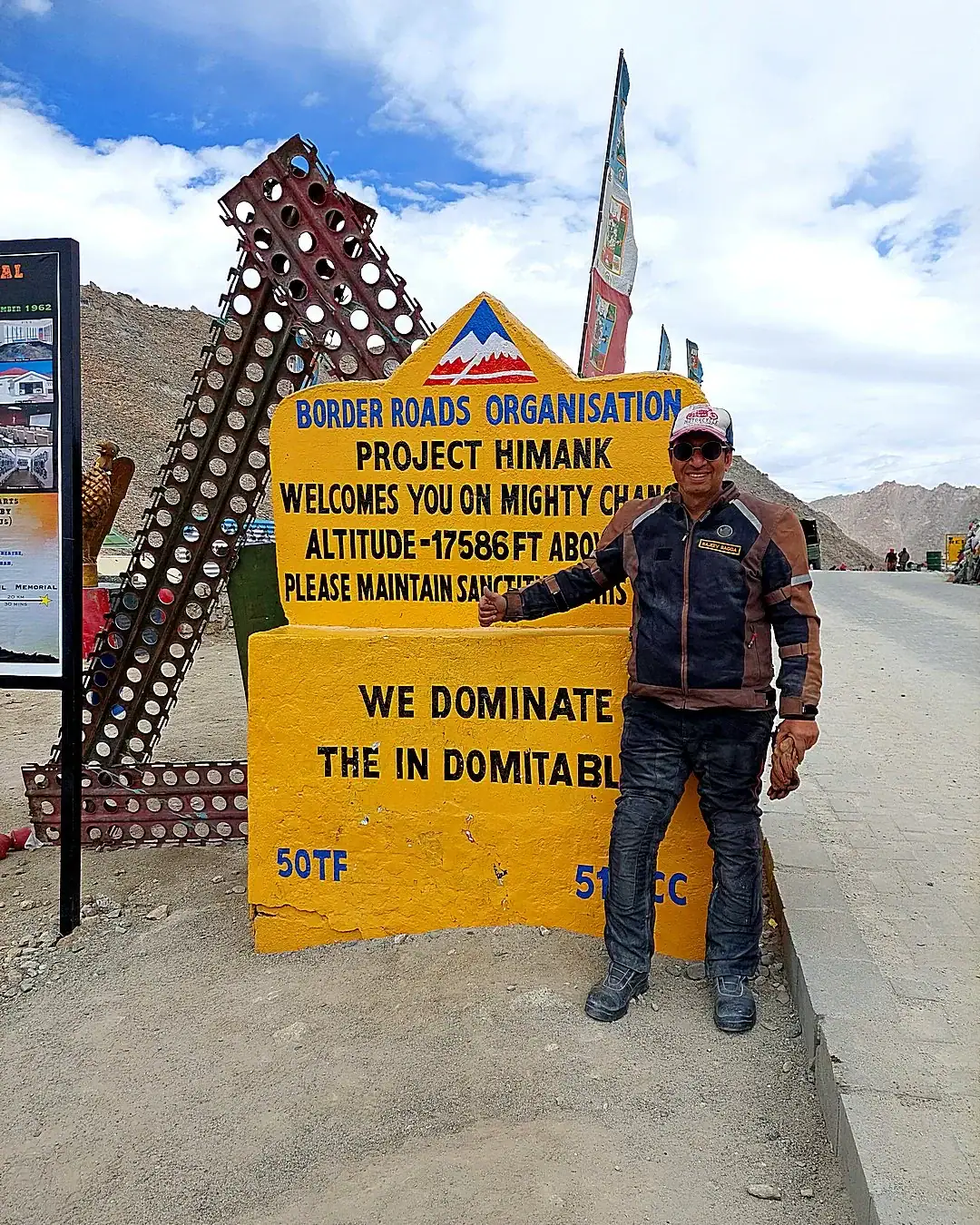
Your engine is an air pump. It sucks in air, adds fuel, lights it and takes the energy. More air, more power. At the top of Khardung La, 17,582 ft, the air is at about half the pressure it has at sea level. The engine gets about half the air and makes about half the power. The math is brutal but honest.
Royal Enfield lists the Himalayan 450 at 40 PS. At the top of the pass, roughly twenty of them turn up for work. Nothing is broken. This is physics, and it happens to every bike on the mountain.
What it changes is you:
- Overtaking. The truck you would pass in twenty seconds at sea level takes forty here. Maybe more. Plan three times earlier, commit fully, and abort if there is any doubt.
- Climbing. Downshift before the engine starts to lug. If you waited until it complained, you waited too long.
- Top speed. Irrelevant. The road will not let you, the altitude will not let you, and your sense of self-preservation should not let you.
The Himalayan is fuel injected, so nobody has to fiddle with a carburetor at the roadside. The injection sorts out the mixture. It cannot manufacture air.
Brakes and throttle get lazy too
Thin air does less to slow you down. There is less drag, less engine braking, and the brakes shed their heat less willingly. Braking distances grow. Brake earlier than you think you need to, especially on the long descent off a pass, when the view is doing its best to distract you.
The throttle goes soft as well. There is a pause between twisting your wrist and anything happening. The engine sounds rougher, as if it is working harder for less, because it is. None of this is a fault. And leave the ABS switched on. Whoever tells you to turn it off at altitude is not the one who will be picking up your bike.
Cold mornings belong to the battery
At the high camps, dawn can sit around freezing even in summer. Batteries give less current. Oil thickens and does not want to circulate. Rubber hardens, tires included, so the first few kilometers have less grip than you remember from yesterday afternoon.
The cold start routine is dull, and it works:
- Park where the morning sun will find the bike. A few degrees matter.
- Key on. Wait until you hear the fuel pump prime.
- Clutch in, to take the load off the starter. Then press the button.
- If it does not catch in three or four seconds, stop. Wait ten. Try again.
- Once it runs, let it idle for two minutes before you ride. Do not blip the throttle to help. The fuel injection knows what it is doing better than you do.
The Ladakh motorcycle preparation that matters takes two minutes
The useful preparation is not in the luggage. It is a walk around the bike every morning, before the helmet goes on:
- Tires: pressure checked cold, and a look for cuts or anything embedded.
- Chain: 35 to 40 mm of free play, lubricated, running straight.
- Brakes: a firm lever, not a spongy one. Pads you can see. No leaks.
- Fluids: engine oil, brake fluid, and coolant if you can see the reservoir.
- Lights: headlight, tail light, brake light, indicators. Sounds basic. You would be surprised.
- Bolts: handlebars, footpegs, mirrors. A single-cylinder engine vibrates, and vibration undoes things.
- The ground under the bike: fresh oil or coolant down there is bad news, and better found in the parking lot than on the pass.
The point is to know what normal looks and feels like, so you notice the morning it changes. “The brakes feel different today” is useful information. “Something is weird but I cannot describe it” is less useful.
The fuel gauge is an opinion
Altitude moves fuel economy in both directions. Less air resistance helps. An engine working harder for less does not. Your usual range estimate is now a rumor. The Himalayan 450 carries 17 liters, which sounds like plenty until you look at where the pumps are.
On Mission High-La we treat Leh as the last certain fuel. The pump at Khalsar exists, queues badly and runs dry. Diskit is the last fuel heading west. Beyond it there is none, all the way to Turtuk, on a day that runs 246 km out and back. Leaving Nubra for Pangong, the next pump is Tangtse, 126 km on, with the whole unpaved section in between.
Ride in from Manali and the gap gets longer and the arithmetic gets religious. That one has its own post: the last petrol pump on the Manali Leh highway.
What actually breaks: levers, plastic and pride
Here is the honest list of what breaks on a Ladakh bike trip. Levers. Plastic. Now and then a footpeg or a handlebar. Almost all of it happens at walking pace or standing still, usually in front of the maximum number of witnesses, because the universe has a sense of humor.
I have dropped bikes in parking lots in front of crowds. Everyone has. When it is your turn:
- Kill the engine.
- Check yourself before the bike. Adrenaline lies.
- Lift with legs and leverage, not your back. There is a technique, and it works for small riders too.
- Look for leaking fluid, bent levers, bent bars or pegs. Cracked plastic is cosmetic. Ignore it.
- Ride a slow test. Does it track straight, do the brakes work, does the clutch engage.
The Himalayan’s crash bars and plastic bodywork are built for exactly this. Most drops cost a few scratches and a bent brake lever.
Then there is the flat tire, which does not wait for a dramatic altitude. Mine came in 2021 in the lower Himalayas, on perfect tarmac in perfect weather, at the exact moment I thought “this is riding heaven”. A man in a Mahindra pickup, on his way home with his daughter’s birthday cake, hauled the bike to the nearest town. It took two hours to get the puncture mended at the only shop in Chakrata. The mountains do not check how well your day was going.
Why a Royal Enfield Himalayan, then
You probably own a better motorcycle than a Royal Enfield Himalayan. More power, better brakes, a seat that does not feel like a plank. For Ladakh it is still the right bike. Not because it is the best. Because it is the most appropriate.
- It can be fixed with basic tools. A decent mechanic can sort most problems in a parking lot with a wrench set and some ingenuity.
- Parts exist. Royal Enfield has dealerships in Leh and Srinagar. Your boutique Italian manufacturer does not.
- It forgives a drop. It does not take a team of sherpas to lift, and it does not cost enough to cause a panic attack.
- Its limits slow you down. At altitude, on uncertain roads, that is what you should be doing anyway.
What we do so you do not carry the workshop
On our Ladakh tours a mechanic travels with the group and a support vehicle carries what the bikes should not. The machines are allocated and checked in Leh during the two acclimatization days, before anyone rides a pass. Those are the same two days your body needs anyway.
It matters more the further out you go. Eastern Ladakh takes you to Mig La at 19,400 ft, and Zanskar: The Hidden Road puts days of riding between you and the workshops of Leh.
The bike’s job is to get you there and do what you tell it, within its limits. Your job is to not ask it for things it cannot do. That is the whole partnership.
A good Ladakh motorcycle tour builds the checks into the day, so the bike is the least interesting thing that happens to you. That is how we run all our Ladakh motorcycle tours.
Ready to ride? This is what Outriders does. Small groups, experienced lead riders, routes that don’t exist on package tours. See the Ladakh motorcycle tour →