Altitude sickness in Ladakh is the one thing on the trip that does not care about you. Not your riding hours, not your gym membership, not the fact that you paid good money and flew a long way. You land in Leh at 11,483 ft, the bike is right there, the sky is absurdly blue, and your body has quietly started filing a complaint.
This is how we deal with it on our tours, and how you should deal with it on yours.
What altitude actually does to you
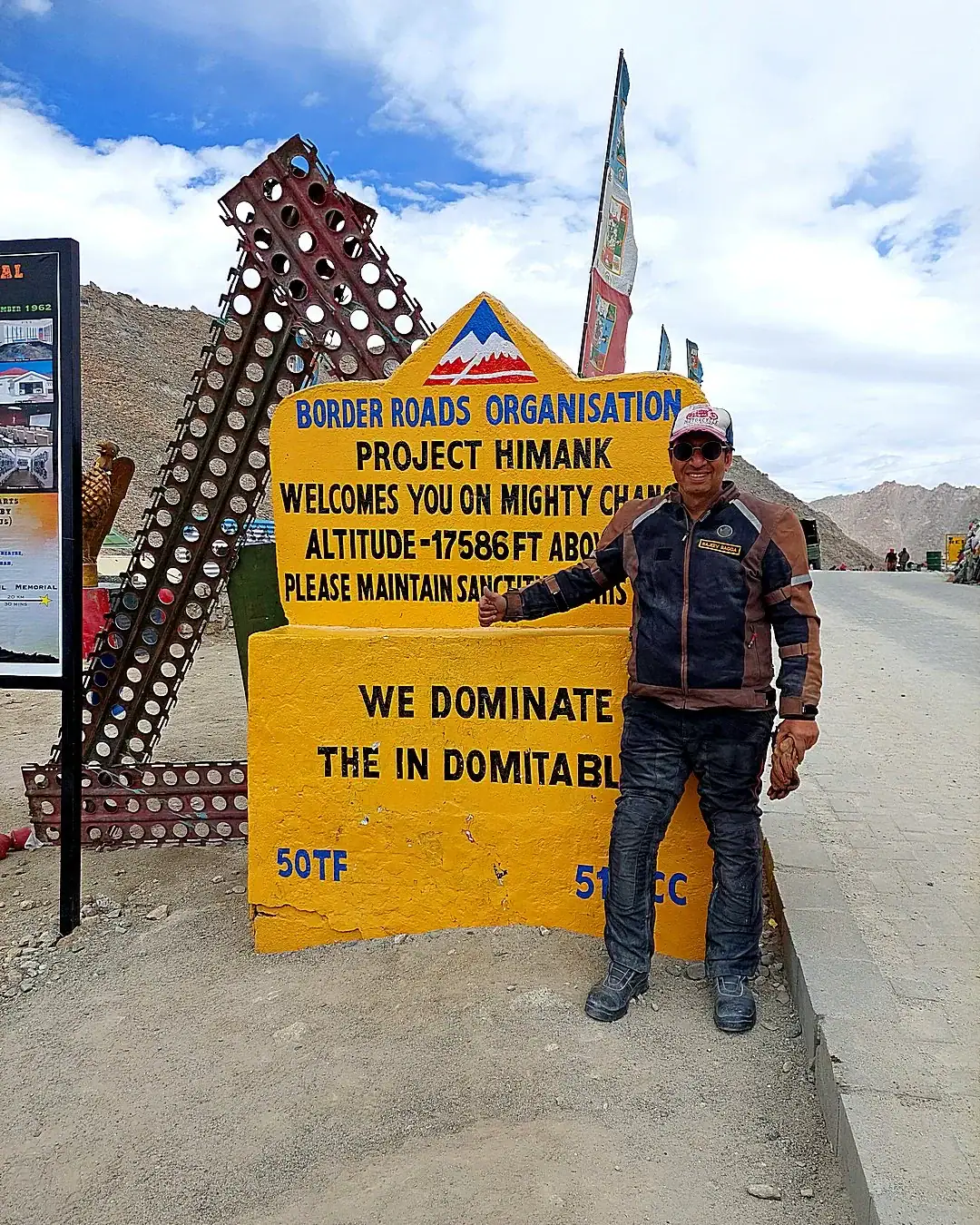
At sea level the air is about 21% oxygen. At Leh it is still 21% oxygen, there is just a lot less air. The pressure is roughly two thirds of what you are used to, so every breath carries about a third less oxygen. At the top of Khardung La, 17,582 ft, you are down to about half. (The sign at the top says 17,982 ft. The survey says 17,582. Either way, it is high.) Your body notices.
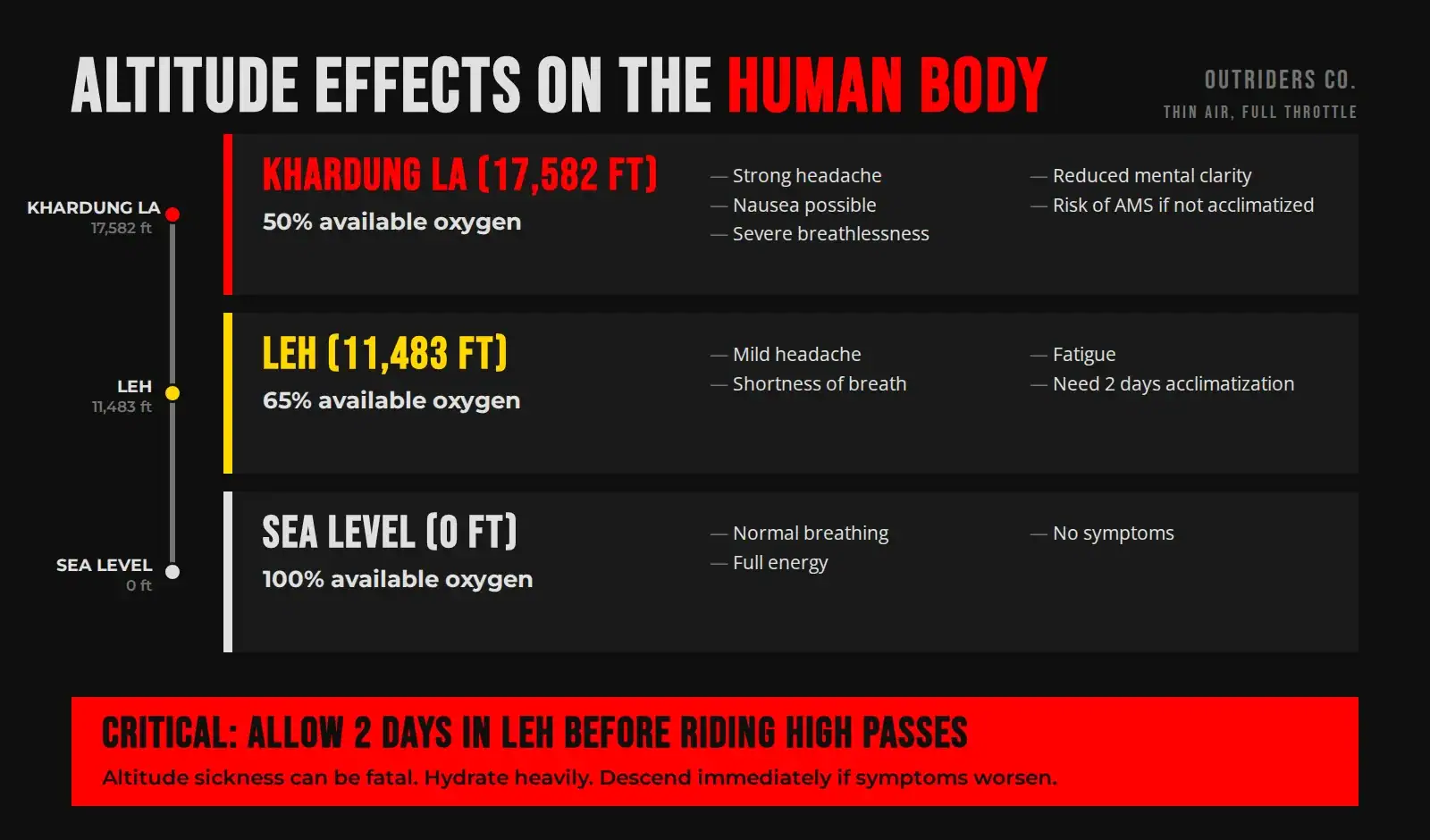
The first few hours you feel fine. Then the headache arrives, mild, like you skipped your coffee. Then a vague unsettled stomach, legs that feel borrowed, and a walk across the hotel car park that leaves you breathing like you ran a marathon. That is Acute Mountain Sickness, AMS, the mild version. It happens to almost everyone. It is manageable. It is also a clear signal not to ride any higher until it clears.
The 48-hour rule in Leh
This one is not my opinion. The Leh district administration asks every tourist arriving in Leh to acclimatize for at least 48 hours before heading to Khardung La or Pangong. Its health advisory adds complete rest for the first 24 to 36 hours, no hard physical effort on the first two days, and no alcohol, sleeping pills or smoking.
Here is what that looks like on a motorcycle tour:
- Day one in Leh: nothing. Rest. Walk slowly. Drink water. Do not ride. I know the bike is right there. Do not ride.
- Day two: a short, gentle ride around Leh. Shanti Stupa, the palace, the confluence of the Indus and the Zanskar. Low effort, low altitude gain, and an honest look at how you feel.
- Day three: now the high passes.
On Mission High-La that is exactly the order: arrive in Leh, an acclimatization and local ride day, then Khardung La. Riders who skip the rest days are the ones who meet the support vehicle and the oxygen cylinder later in the week, from the inside.
Acclimatization in Ladakh after Leh
Leh is only the first step. Once you are above 3,000 m, the CDC Yellow Book advises raising your sleeping altitude by no more than 500 m (1,650 ft) a night, with an extra night for every 1,000 m gained. Ladakh does not always let you obey that to the letter, which is why the principle matters more than the number:
- Ride high, sleep low. Up to the pass, down to sleep. Your body recovers at night. Sleep altitude matters more than the highest point of the day.
- Acclimatization is not linear. Great one day, terrible the next, great again. One good morning does not mean you are done.
- Never go up with symptoms. The CDC puts it plainly: never ascend to sleep higher while you have symptoms of altitude illness, however minor they seem.
This is also why the route in matters. The Srinagar road lets you climb in stages. The Manali road throws you over high passes before you have slept high even once. We compared the two in Manali Leh vs Srinagar Leh.
Water, Diamox and other boring things that work
Water. Dry air, hard breathing and a riding jacket pull water out of you faster than you think. The Leh health advisory asks for 2 to 3 litres a day. On a riding day I drink more. Thirst is a lagging indicator, and dark yellow urine means you are behind. Yes, you will pee constantly. You will learn to appreciate strategically placed rocks.
Diamox. Acetazolamide speeds up acclimatization, and the Leh advisory mentions it. Some riders swear by it, some never need it, and some get tingling fingers and flat-tasting fizzy drinks. I am not a doctor. Talk to yours before the trip, not after the headache.
Fitness. Helps with the riding, not with the altitude. I have watched marathon runners struggle at 15,000 ft and unfit riders breeze through. Altitude does not care about your VO2 max.
Warning signs: when altitude sickness in Ladakh gets serious
Mild AMS is headache, nausea, fatigue and breathlessness. It gets better with rest and time. Two things do not:
- HACE (fluid on the brain): confusion, drowsiness, and walking like you have had several drinks you did not have.
- HAPE (fluid on the lungs): breathless even at rest, a cough, chest tightness, sometimes pink frothy sputum, blue lips or fingernails.
Either one means descend now and get medical care. Losing even 500 m often brings a remarkable improvement. The Leh district health advisory lists SNM Hospital in Leh for emergencies, and it is blunt: HAPE and HACE can be fatal. On a motorcycle there is one more test, and it is the simplest: if you cannot think clearly, you cannot ride safely.
The strange but harmless stuff
You may wake at night feeling you forgot to breathe (you briefly did; it is called periodic breathing and it is common at altitude). Dreams get vivid. Appetite disappears; eat anyway. Tempers get short and sunsets get weepy. That is chemistry, not character. And yes, you will fart more. So will everyone else. Just accept it.
The bike feels it too. Less power, lazier throttle, longer braking. Brake earlier than you think you need to.
The moment you stop noticing
After three or four days something shifts. You are still at 12,000 ft, still slower, still breathing harder. But it is background noise now instead of foreground panic. That is acclimatization. It is when riding gets fun again, and it is the reason our tours spend the first days in Leh doing, apparently, nothing.
By the time Eastern Ladakh takes you to Mig La at 19,400 ft, or Zanskar: The Hidden Road takes you over Shinku La, you want those boring early days behind you. Respect the altitude, do not fight it. It has a better record than you do.
None of this is special to us. Any Himalayan motorcycle tour that lands you at altitude and rides the next morning is selling you a headache, and a Leh Ladakh motorcycle trip is the easiest place in the world to buy one.
Ready to ride? This is what Outriders does. Small groups, experienced lead riders, routes that don’t exist on package tours. See the Ladakh motorcycle tour →