THE EDGE OF REASONABLE DOUBT

CLIFFHANGER: THE PASS OF TRUTH

A Negotiation with Gravity, Carved Through Rock, Ice, and Himalayan Vertigo
The Edge of Reasonable Doubt
Cliffhanger: The Pass of Truth
A Negotiation With Gravity, Carved Through Rock, Ice, and Himalayan Vertigo

WHY RIDE THE SACH PASS?

THE PASS OF TRUTH

The Cliffhanger is not about ticking off another Himalayan pass; it is about engaging with terrain in its most unedited form. This route exists because people needed to move—between valleys, across weather, along mountains that do not negotiate. Originally carved as an entry route into the remote Pangi Valley, the track traces high above the Chandrabhaga River, cutting across a stark mountain corridor often associated with the outer reaches of the Pir Panjal region. The road itself is narrow, unguarded, and functional—built for necessity, not comfort—and that purpose still defines the ride today.

You ride the Cliffhanger because some routes still demand respect rather than speed. The long, physically taxing cliffside stretch—often close to ten hours of sustained riding—forces a different rhythm: slower decisions, cleaner lines, and disciplined energy management. With glaciers above and the river falling far below, the exposure is constant but never theatrical. The landscape removes distraction and excess, leaving only what matters: rider, machine, and terrain. That clarity—earned mile by mile—is the truth of this pass, and exactly why it remains one of the world’s most dangerous yet exciting routes. 

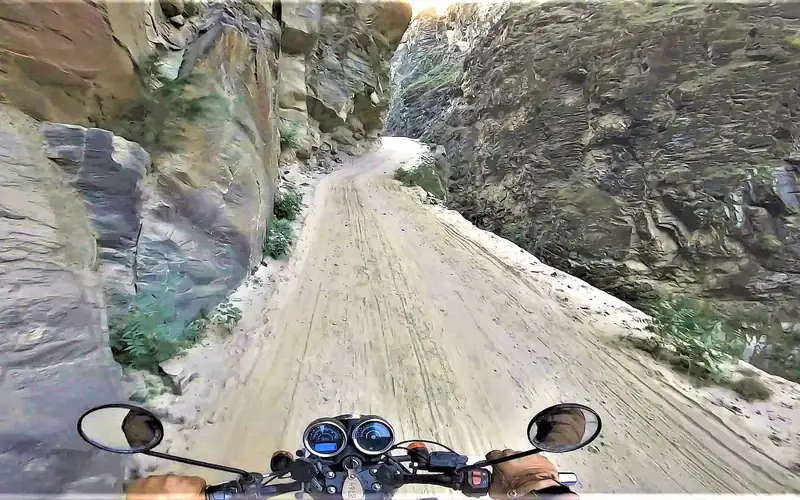
Motorcycle riding through narrow rocky canyon on Sach Pass trail.

TOUR SNAPSHOT

Why Ride The Sach Pass?
The Pass of Truth
Sach Pass
The Cliffhanger is not about ticking off another Himalayan pass; it is about engaging with terrain in its most unedited form. This route exists because people needed to move—between valleys, across weather, along mountains that do not negotiate. Originally carved as an entry route into the remote Pangi Valley, the track traces high above the Chandrabhaga River, cutting across a stark mountain corridor often associated with the outer reaches of the Pir Panjal region. The road itself is narrow, unguarded, and functional—built for necessity, not comfort—and that purpose still defines the ride today.
You ride the Cliffhanger because some routes still demand respect rather than speed. The long, physically taxing cliffside stretch—often close to ten hours of sustained riding—forces a different rhythm: slower decisions, cleaner lines, and disciplined energy management. With glaciers above and the river falling far below, the exposure is constant but never theatrical. The landscape removes distraction and excess, leaving only what matters: rider, machine, and terrain. That clarity—earned mile by mile—is the truth of this pass, and exactly why it remains one of the world's most dangerous yet exciting routes.
Tour Snapshot
📅
Season: June - September
Duration: 14 Days / 13 Nights
📍
Distance: ~1300 Miles
Difficulty: Tough
🏍
Machine: RE Himalayan/Classic

UPCOMING ADVENTURES

Upcoming Adventures
Sep 02 — Sep 15, 2026
4 Seats Left
Start Rider Assessment

HISTORY & HERITAGE

This route moves from old trading towns and crowded plains into mountain regions that were historically isolated for much of the year. The road network leading toward Pangi Valley evolved out of necessity—seasonal movement, trade, and survival in harsh terrain.

For decades, access into these valleys depended on weather windows and local knowledge rather than mapped certainty. Even today, the ride passes through areas where traditions, architecture, and daily life reflect a long relationship with isolation, altitude, and self-reliance.

TERRAIN & CLIMATE

The terrain changes constantly and without warning. Hot plains give way to broken foothills, which then rise sharply into cold, high-altitude mountain zones. Over the course of the route, riders transition from near-sea-level elevations to passes exceeding 4,000 meters, often within a matter of days. 

Weather can shift quickly from heat and dust to wind, cold, and thin air. River valleys, exposed ridgelines, forested stretches, and glacier-fed terrain coexist along the same journey.  

ROADS & LIFE

The ride moves through modern India as it is lived today. Busy cities, chaotic traffic, multi-lane highways filled with trucks and buses, roadside towns, and frequent slowdowns are part of the experience before the landscape opens up. These early stages demand patience, alertness, and precise riding—skills as important here as they are in the mountains.

As the route climbs, infrastructure thins, roads narrow, and settlements become sparse. Mastering this contrast is what defines the completeness of this journey.

Know Your Terrain
Before You Deploy
🏛
History & Heritage
This route moves from old trading towns and crowded plains into mountain regions that were historically isolated for much of the year. The road network leading toward Pangi Valley evolved out of necessity—seasonal movement, trade, and survival in harsh terrain.
For decades, access into these valleys depended on weather windows and local knowledge rather than mapped certainty. Even today, the ride passes through areas where traditions, architecture, and daily life reflect a long relationship with isolation, altitude, and self-reliance.
Terrain & Climate
The terrain changes constantly and without warning. Hot plains give way to broken foothills, which then rise sharply into cold, high-altitude mountain zones. Over the course of the route, riders transition from near-sea-level elevations to passes exceeding 4,000 meters, often within a matter of days.
Weather can shift quickly from heat and dust to wind, cold, and thin air. River valleys, exposed ridgelines, forested stretches, and glacier-fed terrain coexist along the same journey.
🛣
Roads & Life
The ride moves through modern India as it is lived today. Busy cities, chaotic traffic, multi-lane highways filled with trucks and buses, roadside towns, and frequent slowdowns are part of the experience before the landscape opens up. These early stages demand patience, alertness, and precise riding—skills as important here as they are in the mountains.
As the route climbs, infrastructure thins, roads narrow, and settlements become sparse. Mastering this contrast is what defines the completeness of this journey.

ROUTE OVERVIEW: THE CLIFFHANGER RUN

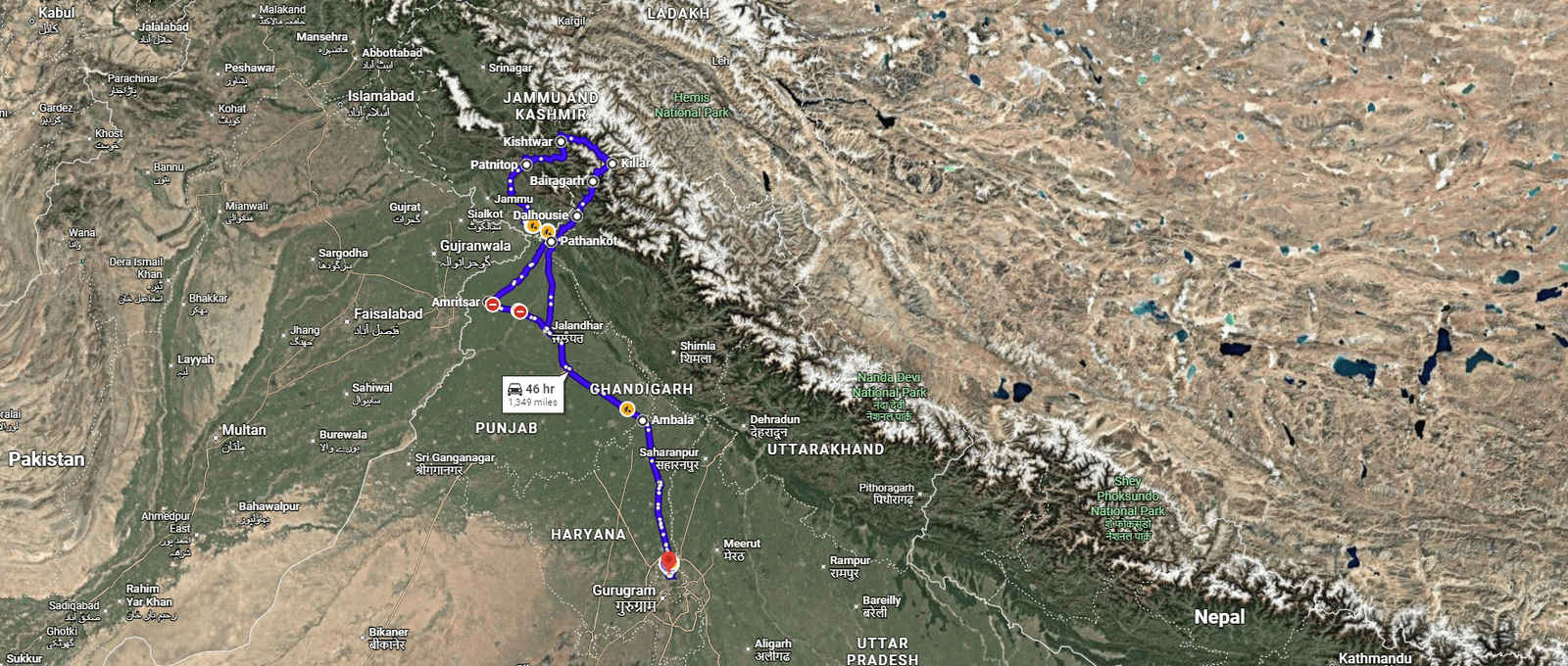
A high-mountain crossing originally built to access the remote Pangi Valley, the Cliffhanger runs on narrow mountain tracks along exposed cliff faces, high above the Chandrabhaga river. The route combines ordinary Himalayan roads with one long, demanding cliffside stretch that defines the ride. Expect long hours in the saddle, changing surfaces, and sustained focus through high-altitude terrain.

Zoom in. Tilt the terrain. Follow the climbs and descents. This interactive route shows you exactly where we ride and rest, and occasionally wonder who convinced us this was a good idea.

Route Overview: The Cliffhanger Run
Where We Ride, Rest, And Occasionally Wonder Who Convinced Us This Was A Good Idea
Cliffhanger Route Map
👆 Tap For Live Satellite View
A high-mountain crossing originally built to access the remote Pangi Valley, the Cliffhanger runs on narrow mountain tracks along exposed cliff faces, high above the Chandrabhaga river. The route combines ordinary Himalayan roads with one long, demanding cliffside stretch that defines the ride. Expect long hours in the saddle, changing surfaces, and sustained focus through high-altitude terrain.
Launch 3D Satellite View

THE FULL ITINERARY

HOW THE DAYS UNFOLD, SUBJECT TO WEATHER, PHYSICS, AND COSMIC IRONY
The Full Itinerary
How The Days Unfold, Subject To Weather, Physics, And Cosmic Irony
Day 01 Map
👆 Tap For Live Satellite View
Day 01
Arrival In Delhi
↑ 700–1000 Feet
Welcome to Delhi — vibrant, loud, and delicious; where aromas, colours, and crowds form the world's most efficient assault on your senses. Exactly the warm-up your senses need before the mountains. Airport pickup, hotel check-in. Evening: Gala Welcome Dinner. You meet the crew, other riders, and your future adventure family. The jokes start early; the bragging rights start later.
Day 02 Map
👆 Tap For Live Satellite View
Day 02
Delhi → Una
↑ 1200–1800 Feet  🏍 230 Miles
Baptism by fire as you punch out of Delhi's chaos and settle into long highway miles across the plains; it's a steady 6–7 hour ride designed to get the machine and your body into rhythm. Overnight is in a comfortable highway hotel in Una—clean rooms, hot shower, early dinner, and an early sleep.
Day 03 Map
👆 Tap For Live Satellite View
Day 03
Una → McLeod Ganj
↑ 6800 Feet  🏍 80 Miles
A shorter 3–4 hour ride, but with concentrated hill-road work—switchbacks, local traffic, and narrow sections that keep you honest. McLeod Ganj is the spiritual and cultural pivot of the route—home of the Dalai Lama and the Tibetan government-in-exile—and you'll overnight in a solid hill-town hotel near the cafés, monasteries, and viewpoints.
Day 04 Map
👆 Tap For Live Satellite View
Day 04
McLeod Ganj → Dalhousie
↑ 6600 Feet  🏍 80 Miles
Expect 6–7 hours of rolling mountain riding with long scenic stretches, patchy road surfaces in places, and a steady accumulation of fatigue. Dalhousie lands you in classic hill-station calm—pine forests, colonial-era charm, and ridge walks—overnighting in a heritage-style hill hotel built for warm beds and slow evenings.
Day 05 Map
👆 Tap For Live Satellite View
Day 05
Dalhousie Rest Day
↑ 6600 Feet  🏍 30 Miles
Dalhousie is a deliberate pause in the itinerary—a day to recover, reset, and prepare for the more remote riding ahead. Easy walks, quiet viewpoints, and unhurried meals make this an ideal place to let fatigue drop before the route turns serious. Optional short ride to Khajjiar, a scenic meadow nearby.
Day 06 Map
👆 Tap For Live Satellite View
Day 06
Dalhousie → Bairagarh
↑ 8200 Feet  🏍 70 Miles
Over 6–8 hours, the route starts feeling less like "tourist Himachal" and more like "working mountains"—roads narrow, services thin out, and the landscape turns quieter and more serious. Bhairagarh is a functional staging stop before the high-pass day, and you'll stay in a simple, clean mountain guesthouse where the priority is early rest and a strong breakfast.
Day 07 Map
👆 Tap For Live Satellite View
Day 07
Bairagarh → Sach Pass → Killar
↑ 8200–14500–8500 Feet  🏍 45 Miles
This is the centerpiece: 9–10 hours of sustained riding that climbs to Sach Pass and then drops into the remote Pangi Valley, where the terrain feels genuinely cut-off from the rest of the map. The cliffside segments above the Chandrabhaga are the "Cliffhanger" signature—narrow tracks, big exposure, relentless focus—followed by an overnight in Killar at a basic local hotel/PWD-style accommodation (simple rooms, essential comfort, real recovery).
Day 08 Map
👆 Tap For Live Satellite View
Day 08
Killar → Kishtwar
↑ 5300 Feet  🏍 75 Miles
This is the true Cliffhanger stretch. The ride from Killar to Kishtwar runs deep through the remote valleys, demanding 7–8 hours of sustained focus on narrow mountain roads with long cliffside sections above the river. Infrastructure remains sparse, the road is often unforgiving, and fatigue management becomes as important as line choice.
By the time you reach Kishtwar, the sense of isolation finally begins to ease. Wider roads, regular traffic, and a comfortable town hotel signal the transition out of the most committing terrain of the tour—without diminishing what the day demands from rider or machine.

Day 09 Map
👆 Tap For Live Satellite View
Day 09
Kishtwar → Patnitop
↑ 6600 Feet  🏍 75 Miles
Around 5–6 hours of cleaner, more predictable mountain riding—forested climbs, steady curves, and viewpoints that feel earned rather than staged. Patnitop is a classic high meadow stop with crisp air and open panoramas, and you'll stay in a hill resort hotel that's intentionally restful after the previous heavy days.
Day 10 Map
👆 Tap For Live Satellite View
Day 10
Patnitop → Pathankot
↑ 1100 Feet  🏍 120 Miles
A 6–7 hour descent brings you back toward the plains: roads broaden, traffic builds, and the riding becomes more about lane discipline than line choice. Pathankot is a practical transit city with a standard business hotel—reliable comfort, easy parking, and a clean reset before Punjab.
Day 11 Map
👆 Tap For Live Satellite View
Day 11
Pathankot → Amritsar
↑ 700 Feet  🏍 80 Miles
A 4–5 hour highway cruise through Punjab's fields and towns, with a lighter riding load and a heavier cultural payoff. Amritsar is the headline stop—time at the Golden Temple (Harmandir Sahib) is non-negotiable—and you'll overnight in a premium city hotel positioned for an easy evening visit and a calm morning.
Day 12 Map
👆 Tap For Live Satellite View
Day 12
Amritsar → Ambala
↑ 900 Feet  🏍 160 Miles
Plan for 6–7 hours on fast, busy highways where trucks, junctions, and urban edges keep you alert even on straight roads. Ambala is your final staging stop, with a business-class hotel chosen for smooth check-in, secure parking, and an early departure.
Day 13 Map
👆 Tap For Live Satellite View
Day 13
Ambala → Delhi
↑ 700–1000 Feet  🏍 130 Miles
A 4–5 hour final run closes the loop—expressways, traffic waves, and the return to Delhi's intensity after days of mountains and remote valleys. You finish where you started, but with a full-spectrum ride behind you: cities, highways, hill towns, high passes, and the raw remoteness of Pangi.
Day 14 Map
👆 Tap For Live Satellite View
Day 14
Departure From Delhi
↑ 700–1000 Feet
Breakfast, airport drop, emotional goodbyes, heartfelt promises to ride again... and a strong chance you'll book the next expedition within a week.

Inclusions & Exclusions

MISSION PAYLOAD

OPERATOR EXCLUSIONS

Inclusions & Exclusions
Mission Payload
Royal Enfield Himalayan or Similar Motorcycle
Fuel and Oil for The Entire Route
All Accommodation (Double Occupancy) & All Meals
Support Vehicle (Luggage & Spares)
Mechanic & Ride Leaders
Airport Transfers
Personalized T-shirt/Hoodie
Gala Welcome Dinner & Farewell Party
Operator Exclusions
International/Domestic Flights
Travel Visa
Personal Travel Insurance
Alcohol & Beverages
Personal Riding Gear
Damages to Motorcycle
Room Service, Laundry, Tips
Anything Not Specifically Mentioned Under 'Inclusions'

ARE YOU A GOOD FIT?

YOU'RE AN OUTRIDER IF

SAVE YOUR MONEY IF

Are You A Good Fit?
You're An Outrider If
You have real off-road experience (loose gravel, rock, mud, broken tracks)
You are comfortable on narrow dirt tracks with big exposure and can keep your head clear when the landscape drops away
You can handle two consecutive "big days" where progress is slow, physical effort is high, and focus must stay sharp for hours
You ride with discipline: you follow the lead, hold formation, respect pacing, and don't chase speed or ego
You want a tour that's intentionally selective—more "earned" than "sold"—and you're fine being vetted before confirmation
You are comfortable riding for long hours on Indian highways and city exits, including aggressive traffic, mixed road users, and unpredictable conditions
Save Your Money If
You are a new rider, returning rider, or have limited off-road time beyond easy gravel
You want to ride with a pillion/passenger (not permitted on the Cliffhanger)
You have a fear of heights/exposure that affects control, decision-making, or composure
You are looking for self-drive / solo unsupported riding (not offered). This is a guided, controlled, and structured route
You struggle with endurance days or you tend to "push through" fatigue by riding aggressively—this route punishes that
You are only comfortable riding in orderly, rule-bound traffic environments and have limited experience navigating mixed, unpredictable highway conditions
Start Rider Assessment →