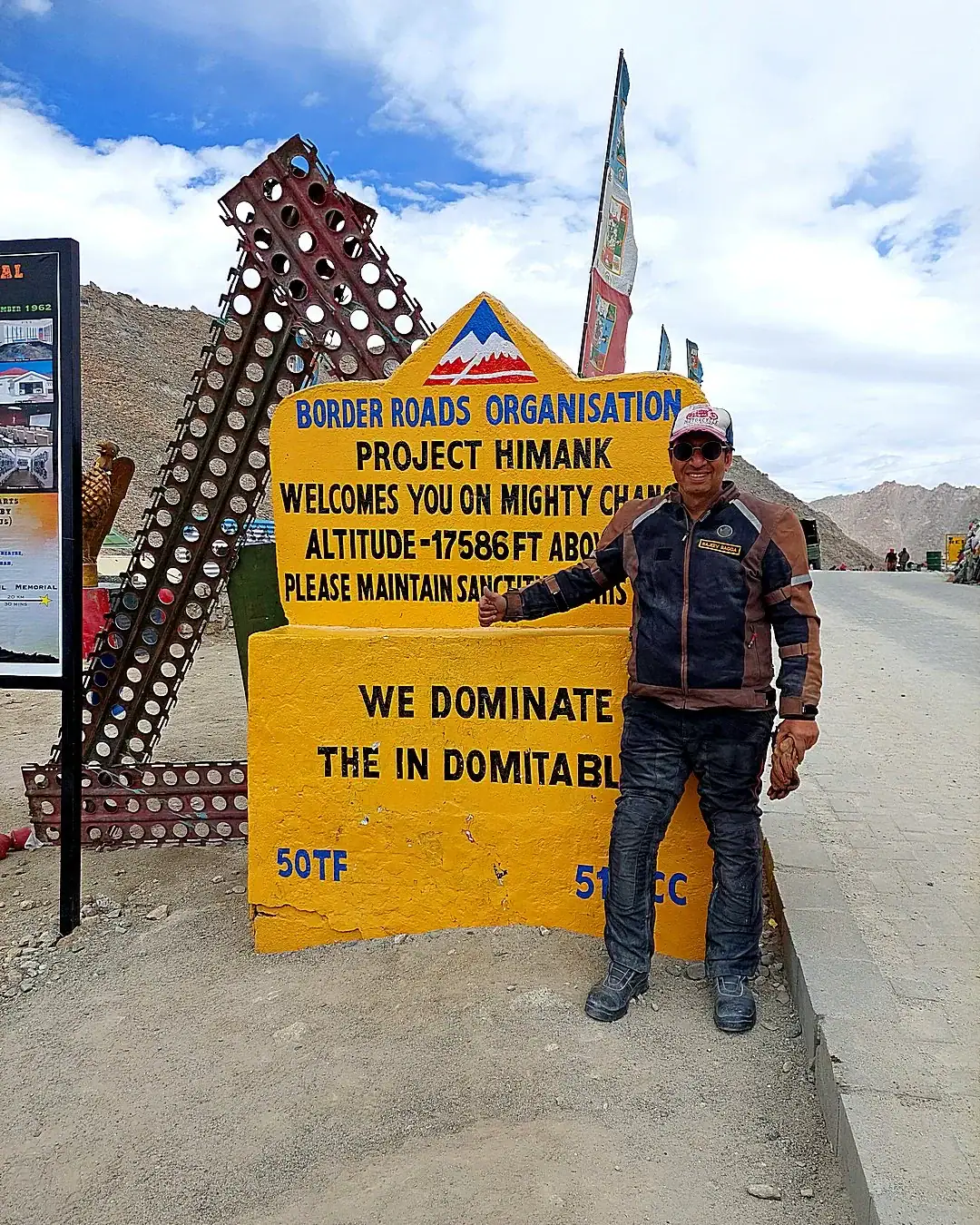
There’s a sign at Khardung La that claims it’s the highest motorable road in the world. This is a lie, but like most lies at 18,380 feet, nobody has the oxygen to argue about it. The sign also suggests you “relax and enjoy the view,” which is advice roughly equivalent to telling someone having a panic attack to just calm down.
I’ve ridden over Khardung La seven times, and each time I’ve arrived at the same philosophical conclusion: human beings are not meant to exist here, and yet we pay good money to do exactly that. There’s something deeply absurd about this transaction – you essentially purchase the right to experience what your body interprets as dying.
The thing about high altitude is that it doesn’t care about your fitness level, your experience, or how many inspirational quotes you’ve posted on Instagram about conquering mountains. Khardung La operates on a simple principle: at this elevation, there’s roughly half the oxygen your brain thinks it needs to maintain the illusion that you’re in control of your life. Your body responds to this shortage with what can only be described as increasing panic mixed with stupidity.
This is where the philosophy gets interesting. Acute Mountain Sickness is essentially your body’s way of telling you that reality has terms and conditions you forgot to read. The symptoms – headache, nausea, dizziness, impaired judgment – are remarkably similar to being drunk, except without any of the fun parts. You’re intoxicated on absence, high on what isn’t there.
I once watched a German tourist at the pass summit argue with his girlfriend about whether they should descend immediately (her position, supported by the fact that she was vomiting) or stay for more photos (his position, supported by the fact that his brain was literally starving for oxygen). The argument had the circular logic of a Catch-22: he couldn’t make good decisions because he lacked oxygen, but he refused to descend to get oxygen because he couldn’t make good decisions.
They stayed. They got more photos. She vomited in several of them. I assume they’re still together, bonded by shared brain damage.
The ride up to Khardung La is a gradual introduction to your own mortality. At 10,000 feet, you feel fine, even energized. This is your body lying to you, a last desperate attempt to maintain morale before things get existential. At 14,000 feet, you notice your heart beating in places hearts shouldn’t beat – your fingertips, your eyeballs, your sense of general wellbeing. At 16,000 feet, you’re breathing like you just ran a marathon, except you’re sitting on a motorcycle going 15 kilometers per hour.
And then there’s the cold. Not the romantic, Jack London kind of cold that builds character. This is the vindictive, personal kind of cold that makes you question every decision that led you to this moment. It’s June. There’s snow. Your hands have stopped feeling like hands and started feeling like distant rumors of hands.
What Khardung La teaches you – what any high pass in Ladakh teaches you – is that the distance between confidence and catastrophe is measured in hundreds of meters of elevation. You can be feeling fine, even cocky, and then suddenly you’re sitting on the side of the road wondering if this is what dying feels like, or if dying would actually be an improvement.
The descent is its own kind of philosophy lesson. As oxygen returns, so does your IQ. You realize, with increasing horror, all the stupid things you just did. The photo where you’re jumping in the air? Your heart was already working at 200% capacity. The decision to “push through” the headache? That was your brain cells crying for help in a language you chose to ignore.
But here’s the thing about Khardung La, about all of Ladakh’s high passes: we keep going back. Not despite the oxygen deprivation and the cold and the very real possibility of cerebral edema, but maybe because of it. There’s something clarifying about being in a place where your body’s needs become so urgent that everything else – your emails, your anxieties, your carefully constructed identity – becomes irrelevant.
At 18,000 feet, you’re not a CEO or a teacher or a traveler with excellent taste in adventure tourism. You’re just a mammal that evolved at sea level, making very questionable choices.
The Buddhist monks who live in Ladakh talk about ego death as a path to enlightenment. I’m not sure riding motorcycles over Khardung La counts as a spiritual practice, but it does give you a taste of what happens when the self you’ve constructed meets the reality of atmospheric pressure. Your ego doesn’t so much die as gasp for air while reconsidering its life choices.
So yes, ride Khardung La. Experience the metaphysics of oxygen deprivation. Just remember: the mountain doesn’t care about your journey of self-discovery. It barely has enough oxygen to care about anything at all.
And for God’s sake, descend before you start thinking the photos are more important than consciousness.
For the record, the two highest motorable roads in the world are now Umling La and Mig La, further east. Our Umling La motorcycle tour rides both in two days, from one village. Khardung La kept the sign anyway.
Ready to ride? This is what Outriders does. Small groups, experienced lead riders, routes that don’t exist on package tours. See the Ladakh motorcycle tour →